Climate Change in the Euro-Mediterranean Region
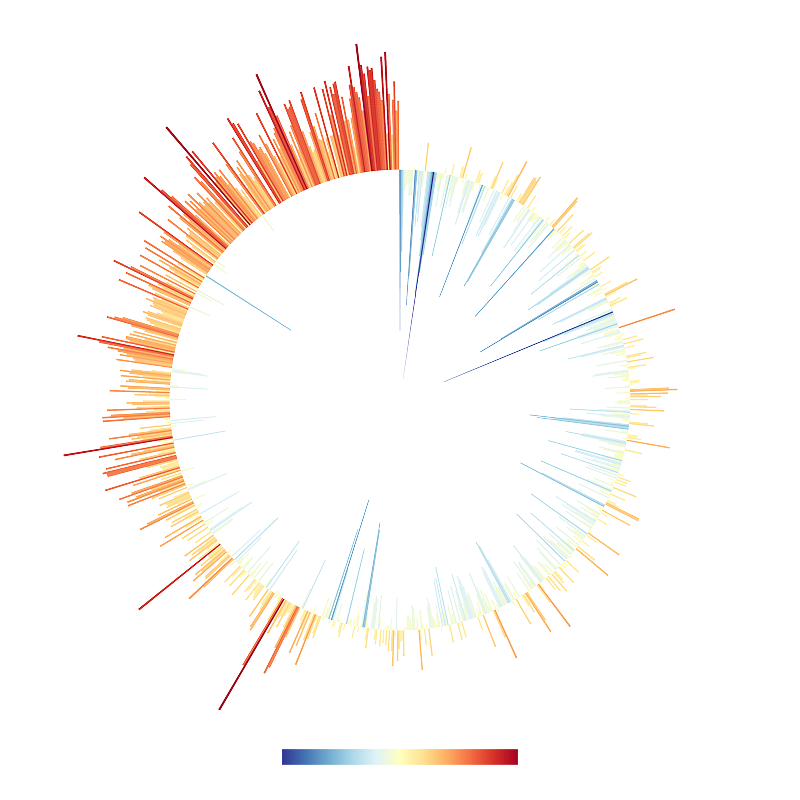
The Euro-Mediterranean region is warming faster than most of the planet. The figure on the right shows more than a century of temperature anomalies relative to a 1970-1999 reference period; blue, inward spokes indicate years colder than the reference, while outward, red spokes indicate years hotter.
This accelerated warming is associated with an intensification of key climate hazards: more frequent and severe heat extremes, prolonged drought conditions, higher fire risk, and stronger storms. These changes are already affecting water resources, agricultural production, energy demand, coastal systems, and terrestrial and marine ecosystems. Several of these impacts are projected to strengthen under all major emissions scenarios.
The Euro-Mediterranean is thus a region where climate change is not only observable in the long-term record, but increasingly central to environmental planning, risk management, and policy design.
The Rapid Uptake of AI in Climate Science
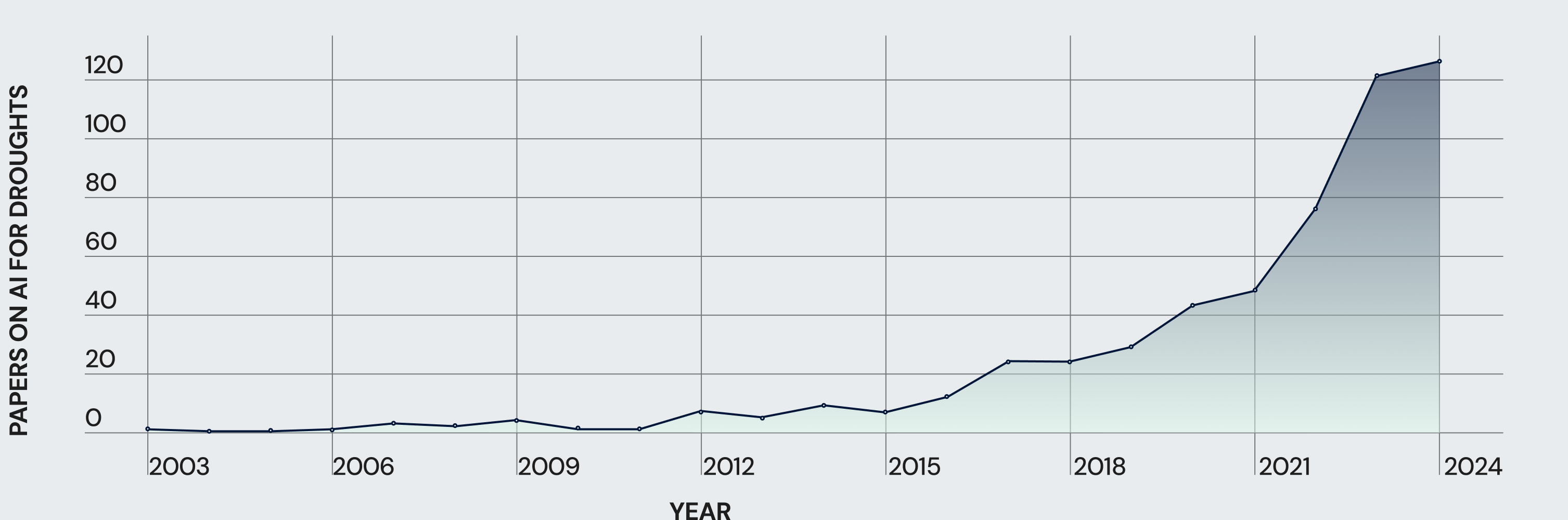
AI and machine-learning methods have expanded rapidly within climate science, particularly for the analysis of extremes, hydrological impacts, and high-dimensional Earth-system data. The figure below shows the temporal evolution of peer-reviewed publications applying AI to drought research, a field that is experiencing exponential growth.
This trajectory reflects broader trends across the discipline. Advances in remote sensing, reanalysis products, large-scale modelling, and data-driven prediction have increased both the availability and complexity of climate data.
In parallel, modern AI methods — including deep learning, probabilistic modelling, and hybrid physical — statistical approaches — have become standard tools for detection, forecasting, downscaling, uncertainty characterisation, and impact assessment.
The uptake of AI in the climate domain is therefore not peripheral but structural, reshaping how the community approaches environmental monitoring and climate-risk analysis.
EUMACC's Mission
EUMACC brings together researchers from across Europe and the Mediterranean to accelerate progress at the intersection of AI and climate science. Our ambition is to create a cohesive, collaborative ecosystem in a region where climate impacts are both severe and unevenly distributed.
We work to:
- Strengthen inter-institutional collaboration and lower the barriers for forming competitive research consortia.
- Increase the visibility, reach, and impact of each other's work through shared communication and collective dissemination.
- Co-organize scientific and outreach activities, from thematic webinars to summer schools that train the next generation of researchers in AI-for-climate methodologies.
EUMACC is thus designed as a knowledge infrastructure: a network that supports long-term cooperation, amplifies scientific excellence in the region, and helps shape the future of climate-AI research in the Euro-Mediterranean area.

Divisions
EUMACC is organized around a set of thematic divisions that reflect the main scientific and methodological areas represented across the network. The divisions provide a light coordination structure: they make it easier to identify shared expertise, connect members around common interests, coordinate proposals and events, and circulate relevant opportunities to the researchers most closely aligned with each topic. As the network grows, the divisions are intended to become the basis for more structured working groups, joint initiatives, and community-building activities.
Advancing AI
This division focuses on researchers developing new AI, machine learning, deep learning, reinforcement learning, computer vision, and data-driven methodologies for climate and environmental science. It brings together members whose work advances the underlying methods, not only their application to climate-related problems.
Earth observation & remote sensing
This division focuses on the use of satellite, airborne, in-situ, and other observational data to monitor and understand the Earth system. It covers methods for extracting, integrating, and interpreting environmental information across land, ocean, atmosphere, cryosphere, and ecosystems.
Climate and Earth system modelling
This division focuses on the modelling and simulation of the climate system and its components, from global and regional climate models to Earth system, hydrological, atmospheric, land-surface, and ecosystem models. It includes work on model development, evaluation, emulation, downscaling, projections, and the integration of AI with process-based modelling.
Natural hazards, extremes, risk, and impacts
This division focuses on climate-related hazards and extremes, their physical drivers, their impacts, and the risks they pose to societies, infrastructure, ecosystems, and economies. It includes work on floods, droughts, heatwaves, storms, wildfires, compound events, exposure, vulnerability, impact modelling, and risk assessment.
Adaptation & resilience
This division focuses on adaptation, resilience, mitigation, sustainability, and decision support in response to climate change and environmental pressures. It includes research on adaptation pathways, climate services, resource management, socio-environmental systems, policy support, and resilient development across atmosphere, water, land, infrastructure, and ecosystems.